How the Feynman Technique Reveals What Students Actually Understand
July 5, 2026
5 min read
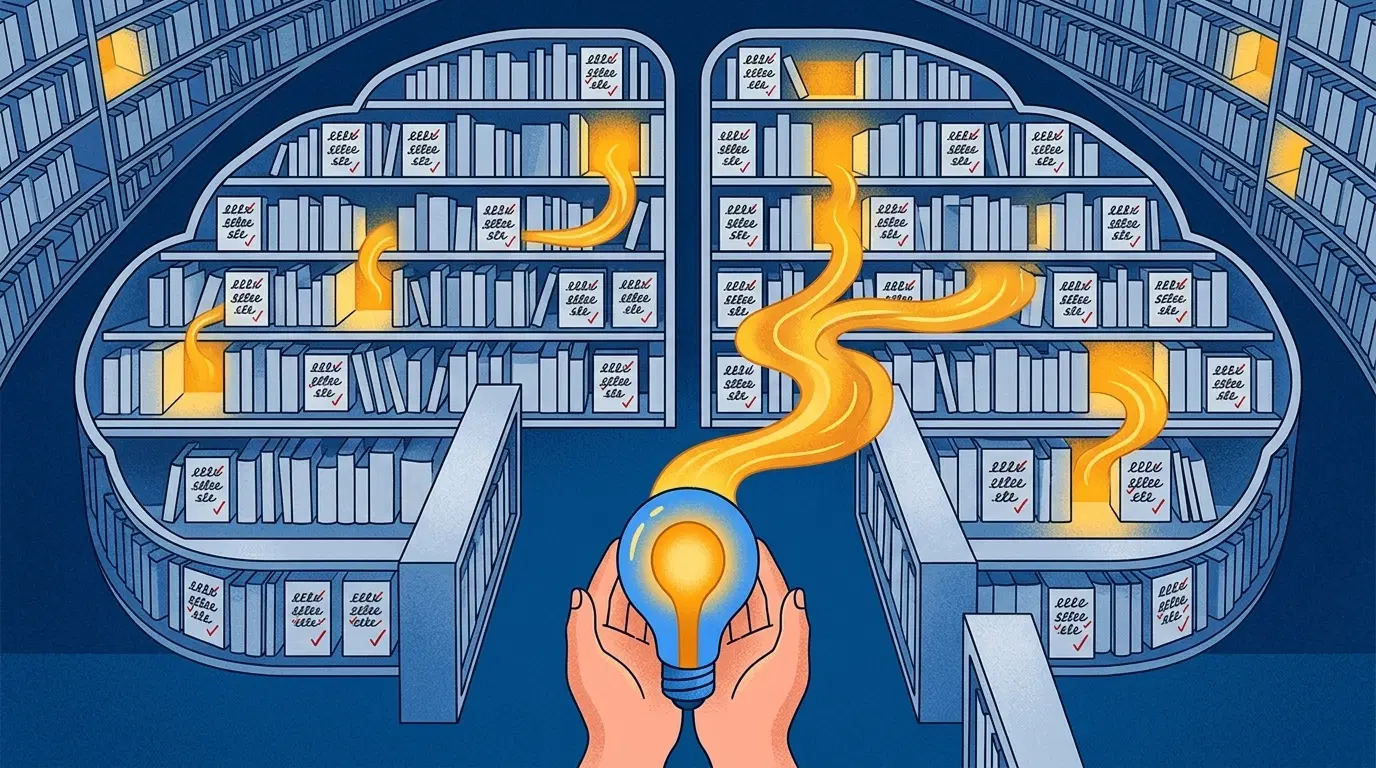
A student can select the correct answer on an exam and still not understand the concept behind it. The Feynman Technique exposes this gap because it forces a different kind of output: an explanation, not a selection. When someone has to teach a concept in their own words, the places where their language breaks down are the places where their understanding breaks down too.
This is not a metaphor. It is a mechanism. Self-explanation, the core act inside the Feynman Technique, has been studied extensively as a learning strategy, and a meta-analysis of 64 reports found it improves learning with a moderate, consistent effect. The technique works because explaining requires a learner to reconstruct a concept from its parts, not retrieve a label for it.
Why explaining is harder than recognizing
Multiple choice questions test recognition. A student scans four options and picks the one that looks familiar, often without reconstructing the underlying logic at all. Teaching removes that shortcut entirely.
When a person has to explain photosynthesis, translate a legal principle, or walk through why a chemical reaction proceeds the way it does, they cannot rely on pattern matching. They have to sequence ideas, connect cause to effect, and anticipate the question a confused listener would ask. Richard Feynman's own method, as described by the University of York's study skills guide, centers on this exact test: if you cannot explain something simply, you have not understood it well enough yet.
That failure point is diagnostic. It tells you precisely where the gap is, not just that a gap exists.
The protégé effect and why teaching changes cognition
Research on the protégé effect shows that people who prepare to teach material engage with it differently than people who prepare to be tested on it. A study published in the Journal of Science Education and Technology found that students working with a teachable AI agent spent more time on learning activities and retained more, with the largest gains among lower performing students. The act of anticipating a learner's confusion changes how a person organizes information before they even open their mouth.
This matters for conceptual mastery assessment because it means teaching is not just a good study habit. It is a different cognitive task from answering a question, and it produces different, more reliable evidence of what someone knows.
A more recent review of learning-by-teaching research, published as part of a study platform design paper, describes this directly: explaining material to others requires synthesizing and structuring it, which surfaces gaps a learner did not know they had. The knowledge gap is not incidental to teaching. It is the byproduct that makes teaching useful as a measurement tool.
What gaps look like when they surface
Not all gaps look the same, and this is where the Feynman Technique becomes genuinely useful for assessment design rather than just personal study.
Some failures are definitional. The student cannot state what a term means in their own words and falls back on the textbook phrasing.
Some are connective. The student can define two concepts separately but cannot explain how one causes or constrains the other.
Some are applied. The student can describe a process abstractly but cannot walk through what happens when a specific variable changes.
A formative assessment platform built around answer selection cannot distinguish between these three failure types. It only records that an answer was wrong. Teaching based assessment records where and how the explanation collapsed, which is a categorically richer signal.
Turning an individual habit into a measurable process
The challenge with the Feynman Technique as most people practice it is that it produces insight for the student but no record for an instructor. A student notices their own confusion; nobody else sees it happen.
This is the problem Axiom Flow was built to solve. Atlas, the platform's assessment designer, generates a configurable set of misconceptions from course material, ranging from five to twenty depending on the depth required. Sam, an AI student, starts out holding those exact misconceptions. The student's job is to teach Sam until its understanding corrects itself.
Because Sam only updates its understanding based on the quality of the teaching it receives, a vague or circular explanation leaves the underlying misconception intact. Sam then takes a constrained exam using only what it was taught, and Atlas scores the result. The final score reflects whether the teaching actually repaired the misconception, not whether the student could recognize a correct answer afterward.
This is what makes Axiom Flow a direct implementation of assessment for learning: the act of teaching Sam is itself the assessment, not a rehearsal for a separate test later. Unlike a standard formative assessment platform that monitors whether a student picked the right option, Axiom Flow measures whether the student's explanation was strong enough to change another mind, artificial or otherwise.
What this means for how mastery gets measured
The Feynman Technique has always contained a built in check on understanding. What has been missing is a systematic way to capture that check at scale, across a class of a hundred students rather than one person narrating to themselves at a desk.
Mapping each misconception to a specific exam question, then testing whether teaching corrected it, turns an informal study habit into structured evidence. The explanation is no longer just a tool the student uses privately. It becomes the artifact an instructor can actually evaluate, tied to a specific gap, corrected or not.
Enjoyed reading this? Share this article with your network.