
How Conceptual Gaps Form and Why Tests Miss Them
September 17, 2026
5 min read
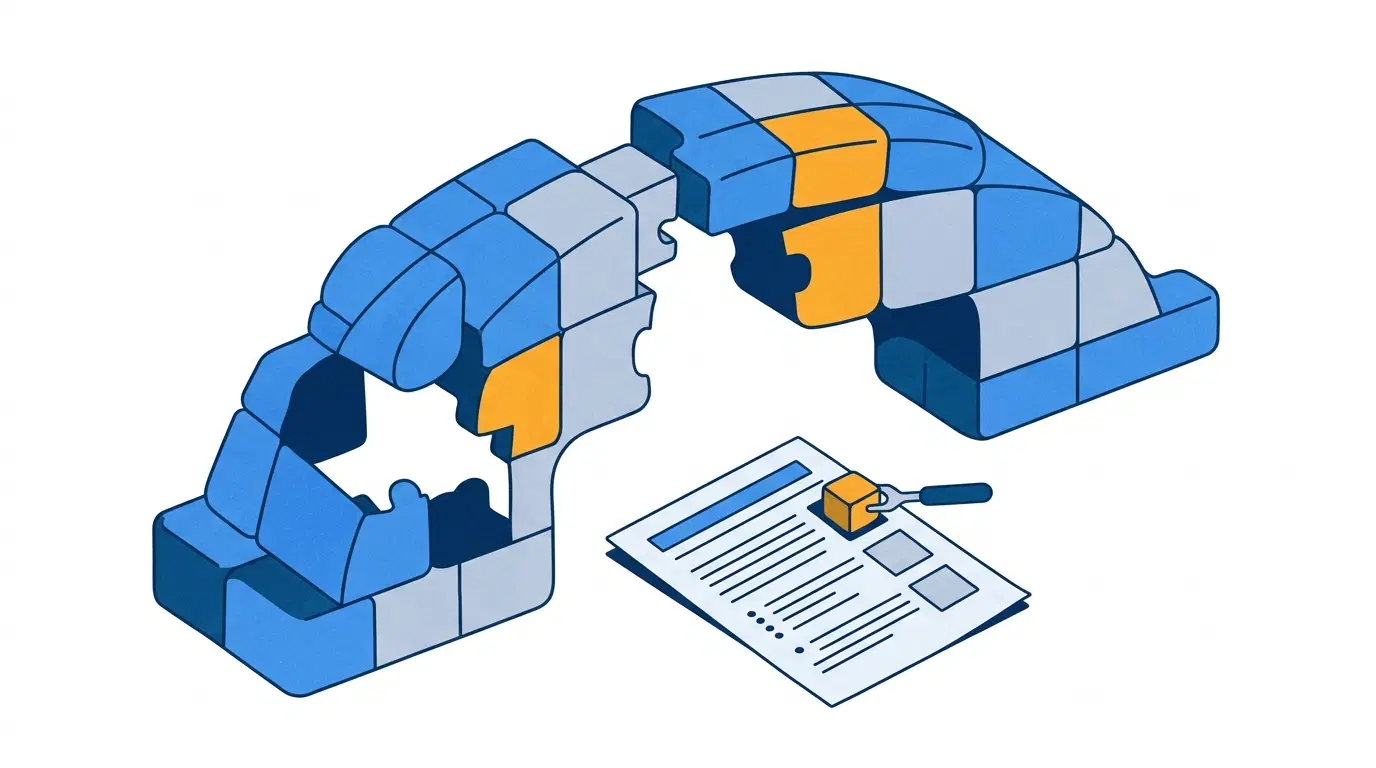
Most conceptual gaps in university students are not left over from school. They form during instruction, sit comfortably alongside correct answers, and pass through exams without leaving a trace. A test that rewards the right output cannot see a flawed model that happens to produce it.
The evidence for this is unusually direct. In a study of biomedical sciences students assessed on cardiovascular physiology, the average score was 3.07 out of 4 when only answers were counted. When students also had to choose the correct explanation, the average fell to 1.57. Roughly half of what looked like understanding was a right answer resting on wrong reasoning.
Gaps Form Inside Instruction, Not Before It
The familiar picture of a misconception is a naive belief a student carries into the room. Those beliefs exist, but they are not the central problem in higher education. Research in Frontiers in Education describes sophisticated misconceptions that emerge after standard disciplinary teaching, where the student's understanding is correct but limited.
This is the more dangerous category. The student has not misunderstood the concept; they have understood a narrower version of it. Their model works on the problems they practiced, which is precisely why nothing in the course flags it as broken.
Three mechanisms produce gaps of this kind. The first is compression, where students reduce a concept to the rule that solved the worked examples and the rule quietly replaces the idea. The second is false anchoring, where new material attaches to a framework that is subtly wrong, so every correct fact reinforces a flawed structure. The third is untested boundaries, where a concept is only ever applied inside the conditions where the partial model still gives the right result.
Why Gaps Get Harder to Remove Over Time
A gap that forms early does not stay isolated. The University at Buffalo's guidance on conceptual change notes that misconceptions resist correction once they connect to other concepts, and that students tend to distort or disregard new information that clashes with a foundational belief. Each subsequent module builds on the flawed model rather than repairing it.
The cost of a missed gap therefore compounds. A student who misreads what a derivative represents in first year does not fail second year calculus immediately. They fail later, in an applied course, where the instructor has no reason to suspect the problem began two semesters earlier.
Why Tests Are Structurally Blind to Gaps
Tests miss conceptual gaps for a structural reason that better item writing cannot fix. A test samples outputs. A conceptual gap is a property of the model that generates those outputs, and correct and flawed models frequently produce identical answers on the same item.
Researchers have tried to work around this with multi-tier diagnostic instruments that add a reasoning question beneath the answer question. These help, but the reasoning options are still predefined, so the student recognizes a plausible explanation instead of producing one. It is the same limitation behind why multiple choice tests measure memory rather than understanding.
Most classroom checks share this blind spot, regardless of whether they sit on the formative or summative side of the distinction between formative and summative assessment. The more useful distinction is between instruments that check outputs and instruments that examine the model producing them.
What It Takes to Surface a Gap
A gap becomes visible when a student has to generate an explanation that someone else acts on. Explanation drags the boundaries of a concept into the open: the student has to state when a rule applies, why it works, and what happens at the edges. A compressed or falsely anchored model fails at exactly those points.
This is the principle behind teaching-based assessment. Unlike a standard formative assessment platform that monitors whether students reach correct responses, Axiom Flow measures whether a student can correct flawed understanding through explanation. Before a session, Atlas analyzes the uploaded learning material and generates a configurable number of misconceptions (5, 10, 15, or 20), mapping one exam question to each.
Sam, an AI student, begins the session holding those misconceptions and has no way to independently check what is true. The student is his only source of correction. Sam asks questions when an explanation is unclear, which pushes the student toward the boundary conditions where partial understanding breaks down. This teaching phase is unscored, and students cannot paste text into it; they type or speak their own explanations.
Once teaching ends, Sam answers the exam questions using only what he was taught. Atlas evaluates those answers and produces an overall score, a record of which misconceptions were resolved, and which gaps remain. This is misconception-based evaluation: the result identifies the specific conceptual errors a student's explanation failed to fix.
Reading the Result as Evidence of Structure
For an instructor, the value is precision. A 70 percent exam score says that something went wrong somewhere. A gap report says which misconception a student could not correct, which is evidence about the structure of their understanding rather than their recall of isolated facts, and it overlaps directly with the goals of diagnostic assessment.
Teachers can also open the full transcript of how each student taught Sam, alongside time spent and active engagement. That transcript shows where an explanation was confident and where it quietly collapsed, which is the point at which the gap formed.
Axiom Flow combines a formative teaching phase with a scored summative exam, and that pairing is what a conceptual understanding assessment requires. The teaching builds and probes understanding at once, and the exam converts it into a result. Conceptual gaps live in the model behind the answers, and an instrument that never reaches that model will keep reporting mastery that does not exist.
Enjoyed reading this? Share this article with your network.