Why AI Grading Is Not the Same as Measuring Understanding
August 25, 2026
5 min read
An AI model can score an essay within one point of a human rater more than 85% of the time and still tell you nothing about whether the student understood what they wrote. Accuracy in matching a human grade is a statement about pattern agreement, not about comprehension. Those are different claims, and higher education keeps treating them as the same one.
The confusion is understandable. AI grading has gotten good at its narrow job: predicting the score a trained rater would assign. Research comparing large language models to instructor and peer grading has found automated scoring systems capable of predicting human scores with accuracy measures approaching those of well-trained expert raters. That is a real achievement in psychometric prediction. It is not evidence that the AI, or the grade it produced, captured what the student actually knows.
Matching a score is not the same as detecting a misconception
Most AI grading tools work by comparing a student's response against a rubric and returning a number. The rubric encodes what a correct answer looks like: structure, key terms, evidence, argument shape. When a response matches those features closely enough, it scores well. When it does not, it scores poorly. Either way, the system is pattern-matching against a target, not interrogating whether the student's underlying model of the concept is sound.
This gap shows up directly in the research. One recent study comparing generative AI scoring to human raters found that GenAI systems were stricter and less consistent than human raters, with correlations between raters ranging from negligible to moderate. If two runs of the same grading model can disagree with each other, the score was never a stable read on understanding to begin with; it was a probabilistic guess dressed up as a measurement.
A separate study on higher education adoption of AI grading reported a related concern: AI grading of essay exams produced results comparable to human grading, but teachers still expressed concern over AI's limitations in assessing creativity or nuance. Nuance is exactly where understanding lives. A student can produce a rubric-compliant answer by memorizing the shape of a correct response without ever being able to explain why it is correct, extend it to a new case, or catch a related misconception. Static scoring has no way to tell the two apart.
Verification requires interaction, not just evaluation
Researchers building on this problem have started proposing fixes that go beyond a single scored pass. One framework built specifically to address this gap combines rubric-based scoring with a second, interactive stage, because static scoring approaches fail to capture process evidence or verify genuine student understanding, and interactive follow-up questioning is essential for diagnosing superficial reasoning. That distinction, between scoring an artifact and probing the reasoning behind it, is the actual fault line between AI grading and AI assessment.
This is where misconception-based evaluation differs structurally from rubric grading. Instead of scoring a finished answer against a target, it starts by identifying what a student is likely to get wrong and then checks whether that specific gap was closed. Axiom Flow's Atlas works this way: before a session starts, Atlas analyzes the uploaded material and generates a configurable set of misconceptions, mapping one exam question to each. Atlas takes no part in the teaching phase itself. Its role is to evaluate, after that phase ends, whether the misconceptions it identified were actually resolved.
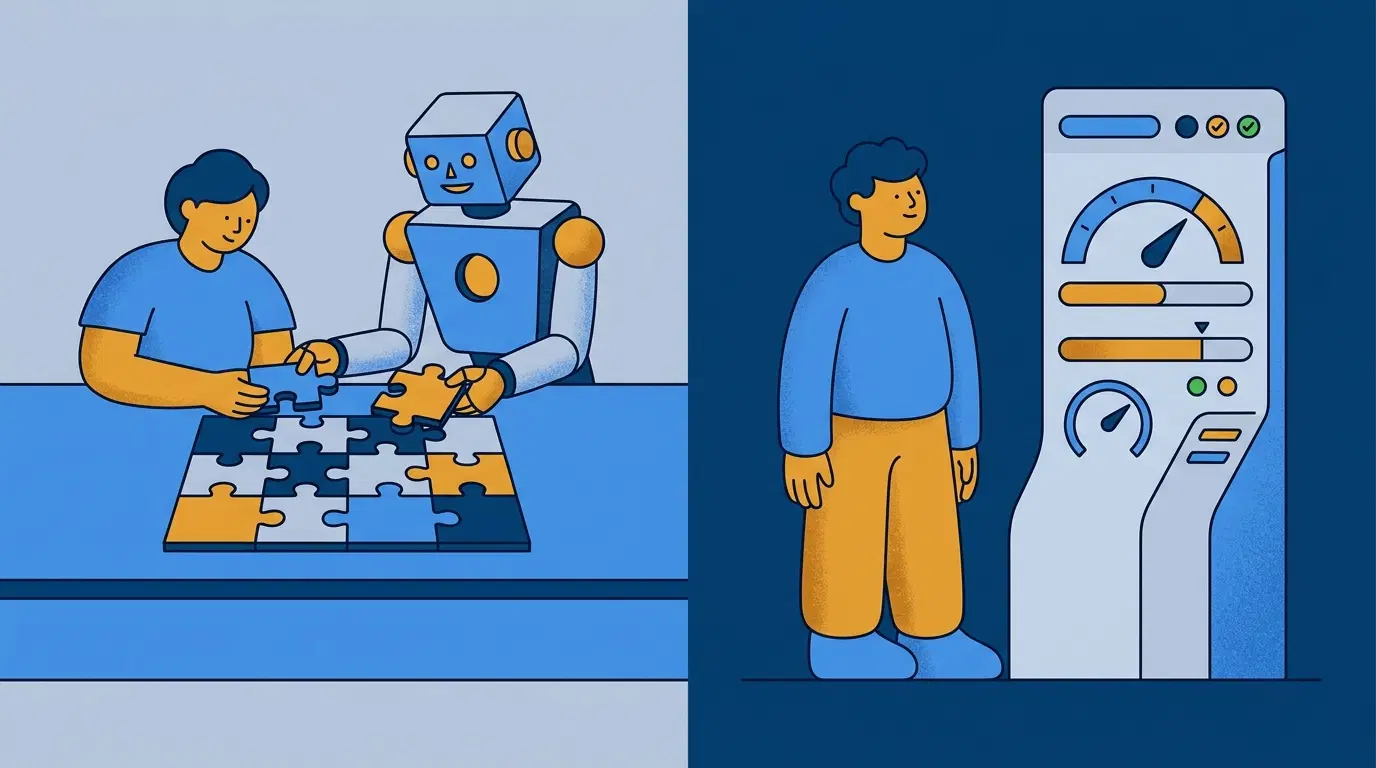
The teaching phase is where the real signal comes from. Sam, Axiom Flow's AI student, starts each session holding those misconceptions and has no outside way to check what is true. The only source of correction is the student teaching him. If an explanation is confused or incomplete, Sam stays confused, because he only reflects back what he was taught. That structure is what separates teaching-based assessment from grading a finished piece of writing: it exposes gaps as they happen instead of scoring around them.
What Atlas measures that a rubric cannot
After teaching ends, Atlas evaluates how Sam answers exam questions using only what he was taught, with no outside knowledge or reasoning of his own to fall back on. If Sam still holds a misconception, the exam surfaces it directly, because the question mapped to that misconception was built to expose exactly that failure. Atlas then produces a score, a list of which misconceptions were resolved, and which remain.
This is not a claim that Axiom Flow is a grading replacement for every use case, or that it is simply a faster version of an ai assessment platform. Unlike standard AI grading tools that score a completed response against a rubric, Atlas is scoring the outcome of a diagnostic process that already tested whether the student's explanation held up under a question Sam couldn't answer from outside knowledge. The teaching phase is unscored practice; the exam is the scored, summative result. Axiom Flow sits between the two rather than claiming to be purely formative.
Institutions evaluating ai powered assessment tools are often comparing accuracy metrics: how close does the AI's score come to a human rater's. That comparison answers a narrower question than the one that actually matters for mastery measurement, which is whether the assessment method can tell the difference between a student who produced the right answer and a student who understood why it was right. Grading accuracy and understanding verification are not the same target, and conflating them is how AI grading tools get treated as if they were conceptual mastery assessment when they were built to do something else entirely.
Enjoyed reading this? Share this article with your network.